
Lee County Arrest Records Path
A Lee County arrest record begins on the custody side. The Lee County Sheriff's Office roster, operated by the agency led by Sheriff Jay Jones, can show the person's name, admit date, arresting agency, booking charge text, bond amount, bond type, bond status, and custody status. That record is useful, but it is not the whole court file. The court side begins when a warrant, complaint, indictment, or other charging document is processed through the Lee County courts. The official local court site is the Lee County Thirty-Seventh Circuit Court of Alabama, and the Circuit Clerk listed there is Mary B. Roberson.
The prosecutor's role is separate from the jail's role. The Lee County District Attorney's Office, led by District Attorney Jessica Ventiere, represents the State of Alabama in felony cases and certain misdemeanor matters in Lee County. A prosecutor may proceed on charges that do not match the exact wording shown on the booking roster. For custody and booking fields, use the Lee County jail inmate records page. For booking photos, use the Lee County jail mugshots page.
Local distinction: A booking charge shows why a person entered the Lee County Detention Center. A court charge shows what the judicial case is about after filing or warrant processing.
Find Lee County Court Records
The official online route for Alabama trial-court case details is Alacourt ACCESS. It is an official statewide court-record portal, but the research file found that it is paid access, not a free county criminal-search page. Alacourt can provide case setting dates, court actions and rulings, party details, case action summaries, financial information, costs, document images, and attachments when those records are available through the system.
The screenshot below comes from the official Alacourt ACCESS portal, which is the statewide case-search channel named in the Lee County research.
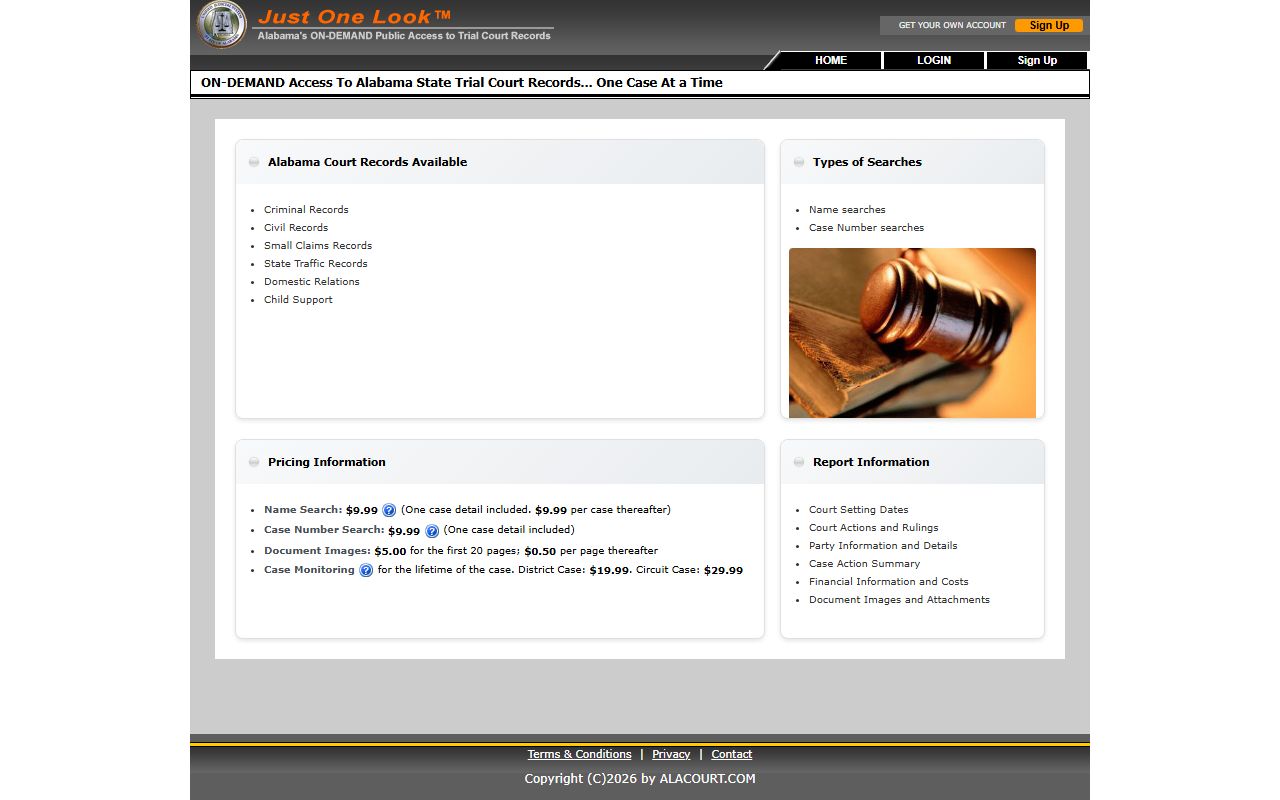
Use the portal for filed case detail, then use the Circuit Clerk copy form when the online screen is not enough or a certified copy is needed.
- Start with the Lee County jail roster if the arrest is recent. Note the defendant name, admit date, charge description, arresting agency, and bond status.
- Search Alacourt ACCESS by name, or by case number when a case number is already known from a court notice or clerk record.
- Open the case detail and compare the filed charge list with the jail booking charge text. Do not assume they will be identical.
- For copies, request the case action summary, indictment, warrant, judgment, last signed order, or complete file from the Lee County Circuit Clerk.
- For Auburn or Opelika city misdemeanors, check the proper municipal court when the county clerk record does not show the case.
| Alacourt ACCESS Field | Type | Required | Lee County Use |
|---|---|---|---|
| Name Search | Search option | Paid | Useful when only the roster name is known. The official page displays a $9.99 name-search price. |
| Case Number Search | Search option | Paid | Best when a summons, bond order, clerk notice, or attorney provides the case number. |
| Document Images | Purchase option | No | The official portal displays $5.00 for the first 20 pages and $0.50 per page after that. |
| Case Monitoring | Monitoring option | No | Shown as a subscription option, with different prices for district and circuit cases. |
Alacourt also has docket-list functions with a county selector, setting date, optional last name field, and a search button. The docket page warns that some cases may not appear electronically, so the clerk's office remains the fallback when a search seems incomplete.
Lee County Charging Documents
After a Lee County arrest, the court record may be built from more than one kind of charging paper. A complaint can start a misdemeanor or early felony process. A warrant can be based on probable cause. A felony case may later involve an indictment returned by a grand jury. The Lee County Circuit Clerk copy/search form lets requesters ask for a copy of a warrant, indictment, case action summary, last signed order, judgment, or complete file, which is more precise than asking for a vague criminal record.
| Document | Who Creates It | What It Usually Shows | How to Request It |
|---|---|---|---|
| Complaint | Officer, complainant, or prosecutor depending on case stage | The accused person, alleged offense, and facts used to start the case or warrant process. | Ask the clerk for the complaint or case action summary if the case is filed. |
| Information | Prosecutor | A formal accusation used in some prosecutions instead of a grand-jury indictment. | Search Alacourt or ask the clerk for the filed charging document. |
| Indictment | Grand jury | The felony charge returned after grand-jury review, often different from the first booking wording. | Use the Circuit Clerk form's indictment checkbox when the case has reached that stage. |
The clerk form is local to Lee County records. It states that the clerk cannot supply federal, municipal, or other-county records. It also says to allow at least 7 working days for copies or searches. That is different from the Sheriff's 15-business-day public-records policy for jail and agency records.
Lee County Charge Status
Charge status can mean different things depending on where it appears. On the Lee County jail roster, charge status and bond status are custody fields. Examples in the official feed include Other non-sentenced, Sentenced, Bonded, Released by Court Order, Active Bond, No Bond, Posted Bond, and Personal Recognizance Bond. In court records, the status usually tracks filed charges, hearings, orders, dispositions, costs, and judgments. A person can be released from jail while the criminal case remains pending.
| Status | Roster Meaning | Court-Record Meaning |
|---|---|---|
| Pending | The person may still be held or recently booked while the case develops. | The charge has not reached final judgment, dismissal, plea, or trial result. |
| Amended or reduced | The roster may not update old booking text to match every court change. | The prosecutor or court changed the filed charge, level, count, or wording. |
| Dismissed | A release order may appear, but the roster is not the full dismissal record. | The court record should show an order, notation, or case action summary entry. |
| Bonded | Bond was posted or processed for a charge or custody status. | The case may continue after release, with hearings and future court dates. |
| Sentenced | The person may be serving a jail sentence or held under sentence status. | The judgment or sentencing order controls the final conviction and penalty. |
Bond information deserves special care. A Lee County roster record can show one charge with active bond and another with no bond. A U.S. Marshals hold, immigration hold, probation issue, or other detainer can also keep a person in custody even when local bond is posted. Verify controlling bond and release orders with the court or jail before relying on a single roster line.
Bond After Lee County Arrest
Alabama criminal rules shape what happens after arrest. Rule 4.3 addresses probable-cause review after a warrantless arrest when a person remains in custody. Rule 4.4 addresses initial appearance, including notice of charges, rights, counsel issues, and release conditions. Rule 7.2 addresses release on recognizance or bond and distinguishes bailable cases from those where bail may be denied under state law.
- Personal recognizance bond
- Release based on a promise to appear, rather than payment of a full cash bond.
- No bond
- A charge or hold where ordinary bond posting is unavailable at that time.
- Purge bond
- A payment or condition often tied to contempt or child-support enforcement in local roster examples.
- Detainer or hold
- A custody basis from another agency or court that may stop release after local bond is addressed.
The Sheriff's public pages did not publish a detailed bond-posting page, payment method list, or bond-counter hours in the research. The practical route is to read the official roster bond fields, then call the Lee County Sheriff's Office or detention center at (334) 749-5651 or verify the court order through the clerk or magistrate channel.
Lee County Warrants Records
The Lee County Magistrates & Warrants page explains that magistrates are part of the judicial branch and must exercise independent judgment. It also says an arrest warrant is not public until served. No official online public active-warrant search was located for Lee County. A person who suspects a warrant exists must appear in person at the Lee County Sheriff's Department.
Jurisdiction matters. The Lee County warrant magistrate handles misdemeanors outside Opelika or Auburn city limits, felonies that occur in Lee County, most state trooper or county deputy traffic cases, and worthless checks received in Lee County. Misdemeanor charges inside Opelika or Auburn city limits generally route through the municipal court unless a felony or unusual circumstance is involved.
| Question | Official Lee County Route |
|---|---|
| Is there an unserved warrant? | No online public search was found. Official guidance requires in-person contact at the Sheriff's Department. |
| How is a warrant requested? | File an incident or offense report, complete the deposition process, and work through the proper magistrate or municipal court. |
| Can I get a served warrant copy? | The Circuit Clerk copy form includes a copy-of-warrant checkbox, subject to court rules and restrictions. |
Lee County Charges vs Convictions
A Lee County arrest record should not be read as proof of guilt. A charge is an accusation or custody reason. A conviction is a final court outcome based on a plea, verdict, or judgment. Court records after arrest can show how a charge moved from the booking stage to dismissal, amendment, plea, trial, sentencing, or another result.
| Point of Comparison | Charge | Conviction |
|---|---|---|
| Stage | Accusation, warrant, complaint, indictment, or filed count. | Final court result after plea, verdict, or other judgment. |
| Proof level | May begin with probable cause or a charging decision. | Requires the legal standard needed for conviction or an accepted plea. |
| Where to verify | Alacourt, clerk records, warrant papers, or filed charging documents. | Judgment, sentencing order, case action summary, or certified court copy. |
| Risk of confusion | Booking text may be old or broad. | Final disposition may be narrower, different, or not guilty. |
Sealed Lee County Arrest Records
Alabama court-record privacy rules say public access is available unless a record is restricted by law, court rule, or court order. Confidential categories can include juvenile records, youthful-offender records, grand-jury material, presentence and diagnostic reports, health and mental-health reports in criminal proceedings, probation or parole reports, and law-enforcement records involving a child. The Sheriff's and DA records policies also list expunged records, unexecuted warrants, open investigative material, and criminal-history information as exceptions.
| Point of Comparison | Sealed or Restricted | Expunged |
|---|---|---|
| Basic effect | Public access is limited or blocked by law, rule, or court order. | An eligible Alabama criminal record is cleared through the statutory expungement process. |
| Legal source | Alabama Rules of Court-Record Privacy and Confidentiality and related statutes or orders. | Alabama Code Title 15, Chapter 27 and court orders. |
| Who grants it | The court or law controlling the confidential record category. | Alabama courts, not ALEA alone, grant expungements under the process described by ALEA. |
| Practical search result | A public user may see no record or a redacted record. | The record may be withheld from public view after the court grants relief. |
Public-records law does not mean every court or jail file is open. Alabama Code Section 36-12-40 gives Alabama residents a right to inspect and copy public records, subject to exceptions. The Sheriff's records page applies Alabama public-records procedures as amended by Act 2024-278 and requires Alabama residency proof for Sheriff's records requests.
Lee County Clerk and DA Records
For filed court records, the Lee County Circuit Clerk copy/search form is the main offline route. It asks for contact information, criminal or civil type, defendant name, charge, case number, date of birth, requested copy type, and certification choice. It states copy fees of $25.00 for 1 to 20 pages, $0.50 for each added page, $5.00 per certification, and $25.00 for paper-record searches, history checks, closed cases, registers, or archived records. Fees are due when the request is received, and the form says no credit card or personal checks.
The official Lee County DA open-records page is a different channel. DA records may include prosecutor-held materials, but the DA guidance says filings, orders, or dispositions available on AlaCourt should be requested from the Circuit Clerk. The screenshot below comes from the official Lee County District Attorney site, which names the prosecution office involved after many felony and certain misdemeanor arrests.
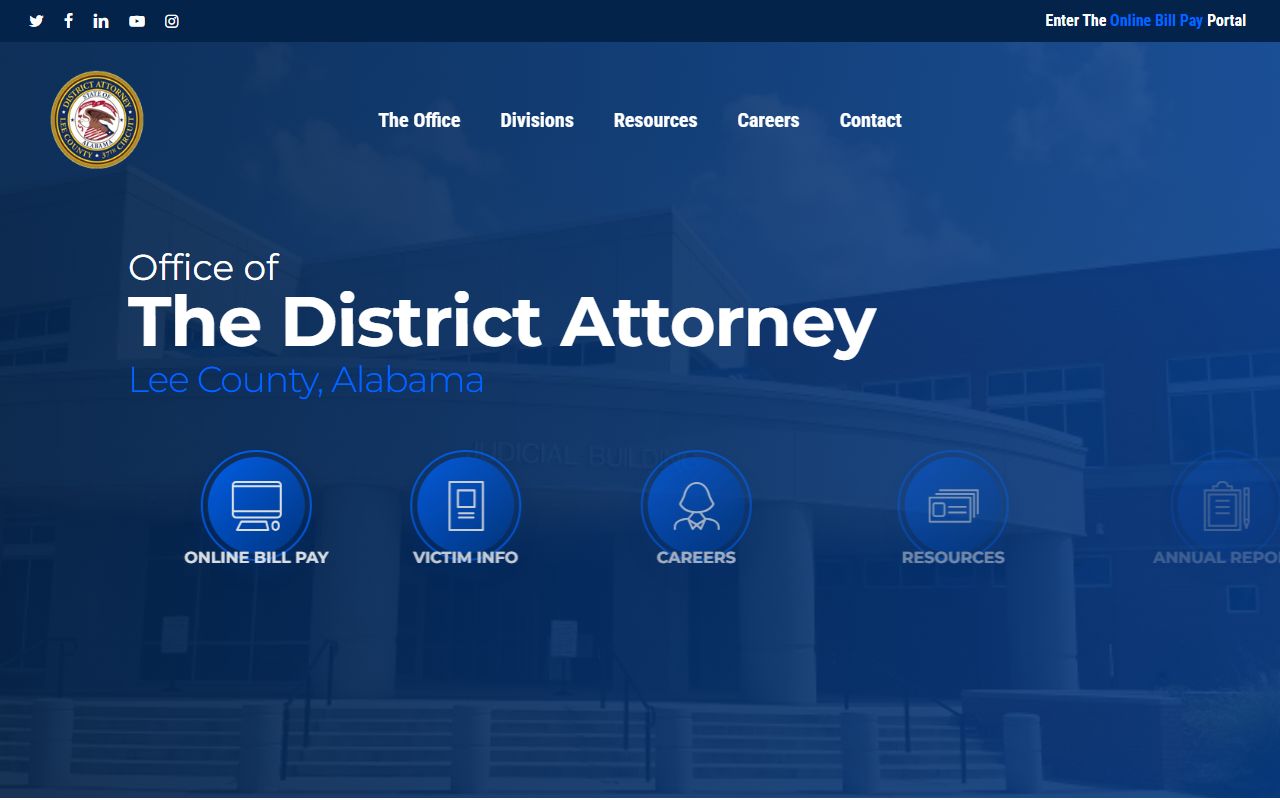
That routing rule keeps requests focused: court-file copies go to the clerk, prosecutor records go to the DA, and jail booking records go to the Sheriff's Office.
Records-use warning: Do not use casual arrest, custody, or court lookups for employment, credit, insurance, tenant screening, or any other FCRA-covered purpose.
Restricted Lee County Court Records
Some Lee County court records after arrest may be public in part and restricted in part. Juvenile matters, youthful-offender material, grand-jury information, child-related law-enforcement records, sealed records, expunged records, and open investigative material can be withheld or redacted. A served warrant may become part of a court file, while an unserved warrant is not treated as a public record under the local warrant guidance.
Federal and immigration cases use different systems. If the jail roster lists U.S. Marshals as the arresting or holding agency, the controlling docket may be in federal court and not in the Lee County Circuit Clerk file. Sentenced state-prison custody should be checked through ADOC, federal sentenced custody through the BOP locator, and immigration custody through ICE ODLS. Note: a no-result search in one system does not prove that no case, hold, release, transfer, or sealed record exists.